Studio I
Chen Wen Hsi. c. 1959-61, Mural Painting, 178 x 420 cm
b. 1906, Baigong Village, Guangdong Province, China - d. 1991, Singapore
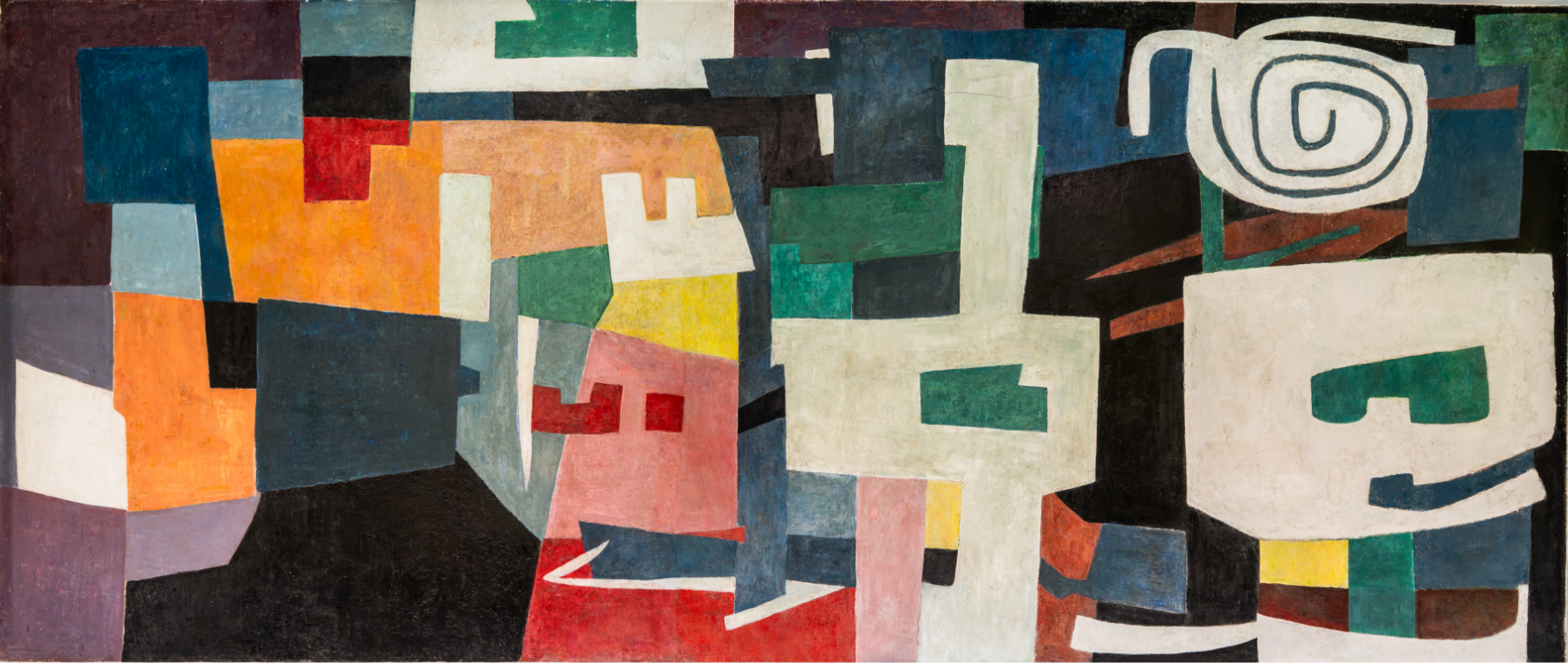
Chen Wen Hsi (1906-1991) was one of Singapore's most important pioneer artists and art educators. His work played a crucial role in shaping the Nanyang art style, which fuses Chinese art traditions with Western modernist influences and Southeast Asian themes. Chen’s earlier art training in China grounded him in classical Chinese aesthetics, particularly calligraphy and ink painting, while also exposing him to Western Modern art movements like Cubism and Post-Impressionism. By the time he settled down in Singapore in 1949, he excelled in both oil painting and traditional Chinese ink, often moving effortlessly between the two.
In 1958, Chen moved from the teachers’ quarters at the Chinese High School to his new house at 5 Kingsmead Road, located less than a kilometre from the campus. Around a year later, he had a stretch of double-sided wall specially constructed near the front porch and spent the next few years creating an abstract mural piece on each side. Studio I, which stands at a monumental size of 178 x 420 cm, is the bigger of the two murals.
Like many of his Shanghai-trained contemporaries, Chen’s oil style in the period of 1950s-1960s carries the imprint of the Paris School - influences of Impressionism, Post-Impressionism, Fauvism, and Cubism - and reflects his concern with inner expression, structure, and visual innovation. This is also evident in Chen’s visual language for Studio I, a composition built from flattened picture planes, fragmented forms, bold colours, and overlapping geometric shapes.
There are no recognisable elements in the composition, though certain shapes combine to evoke suggestions of human or animal figures. The careful juxtaposition of colour blocks generates rhythm and depth, adding to the work’s lively and poetic mood. Like many of Chen’s abstract oils, Studio I demonstrates his ambition in pushing artistic boundaries and integrating broader global art trends in his formal aesthetics.
Compositional Breakdown
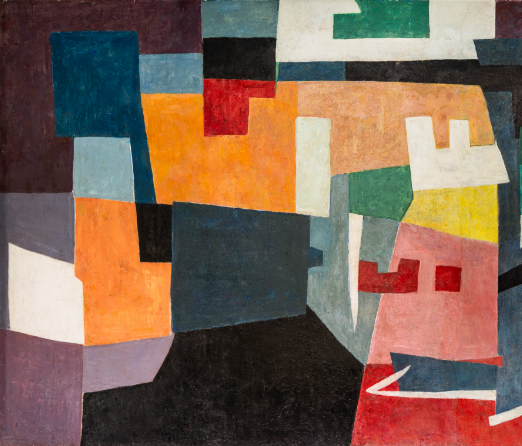
The image comprises a flat picture plane—there is no background or middle ground; all elements interact meaningfully in the foreground.
Chen plays with the juxtaposition of fragmented forms, bold colours, and overlapping geometric shapes.
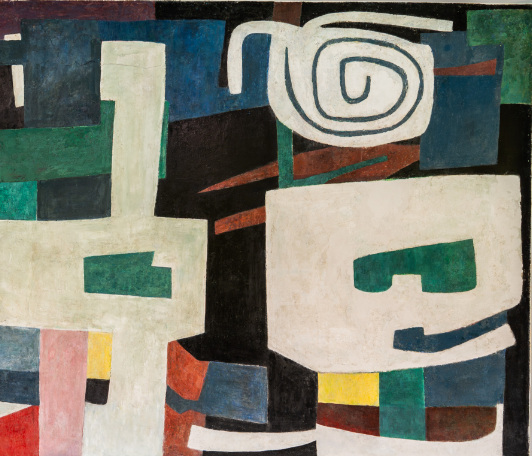
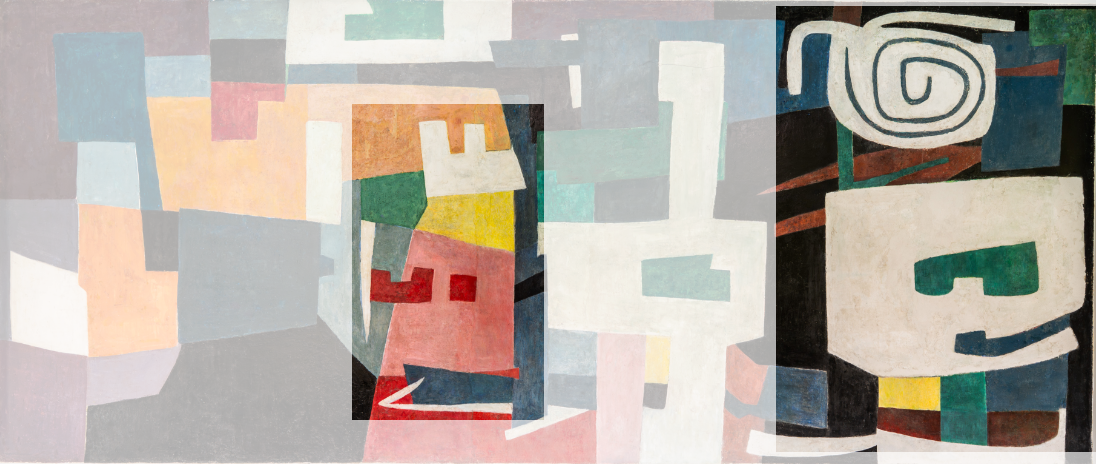
There are no recognisable forms in the composition, though certain shapes combine to evoke suggestions of human or animal figures.