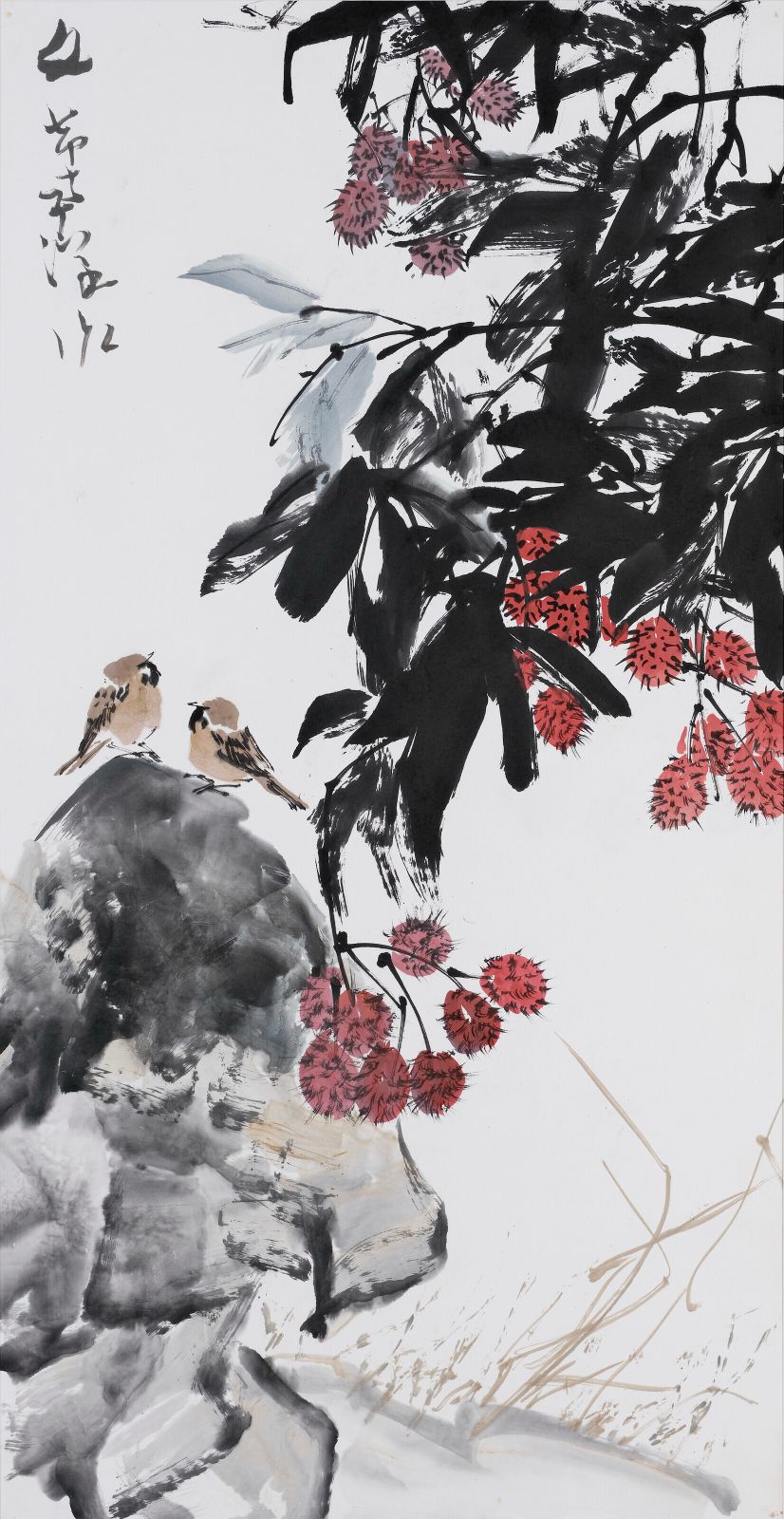
Two Sparrows with Rambutan Tree
Chen Wen Hsi. c. 1960s, Ink and colour on rice paper, 89 x 45 cm
b. 1906, Baigong Village, Guangdong Province, China - d. 1991, Singapore
Chen Wen Hsi (1906-1991) was one of Singapore's most important pioneer artists and art educators. His work played a crucial role in shaping the Nanyang art style, which combines Chinese art traditions with Western modernist influences and Southeast Asian themes. Chen’s paintings range from abstract oils to detailed ink depictions of animals, landscapes, and scenes of daily life. Some of his most famous works focus on gibbons, egrets, squirrels, and sparrows, which he captured with astonishing vitality and grace.
In Two Sparrows with Rambutan Tree, Chen blends traditional Chinese techniques with personal observation to create this elegant picture of two small sparrows gracefully interacting on a textured rock. Above them, a rambutan tree extends diagonally, heavy with broad leaves and round, spiky fruits.
Chen balances density in detail with openness of space to create a lively and harmonious composition. The leaves are rendered with bold, calligraphic strokes in rich black ink, contrasted with some dry strokes to create texture and tonal variation. The rambutans are painted in varying shades of red, complete with fine black lines to suggest their rough spikes. The sparrows are depicted with minimal but precise strokes, capturing their spontaneous form and interaction through posture and gaze. This duality - between softness and structure, detail and abstraction, spontaneity and control - is a philosophy deeply rooted in Chinese literati tradition and a hallmark of Chen’s style.
Compositional Breakdown
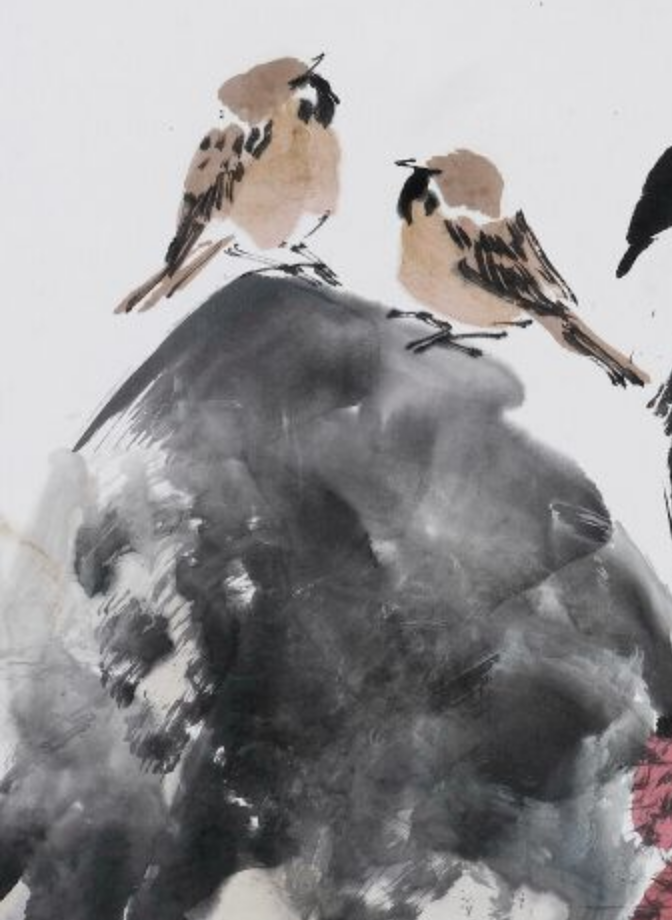
The sparrows are depicted with minimal but precise strokes, capturing their spontaneous form and interaction on a textured rock through posture and gaze.
Above the sparrows, a rambutan tree extends diagonally, heavy with broad leaves and round, spiky fruits.
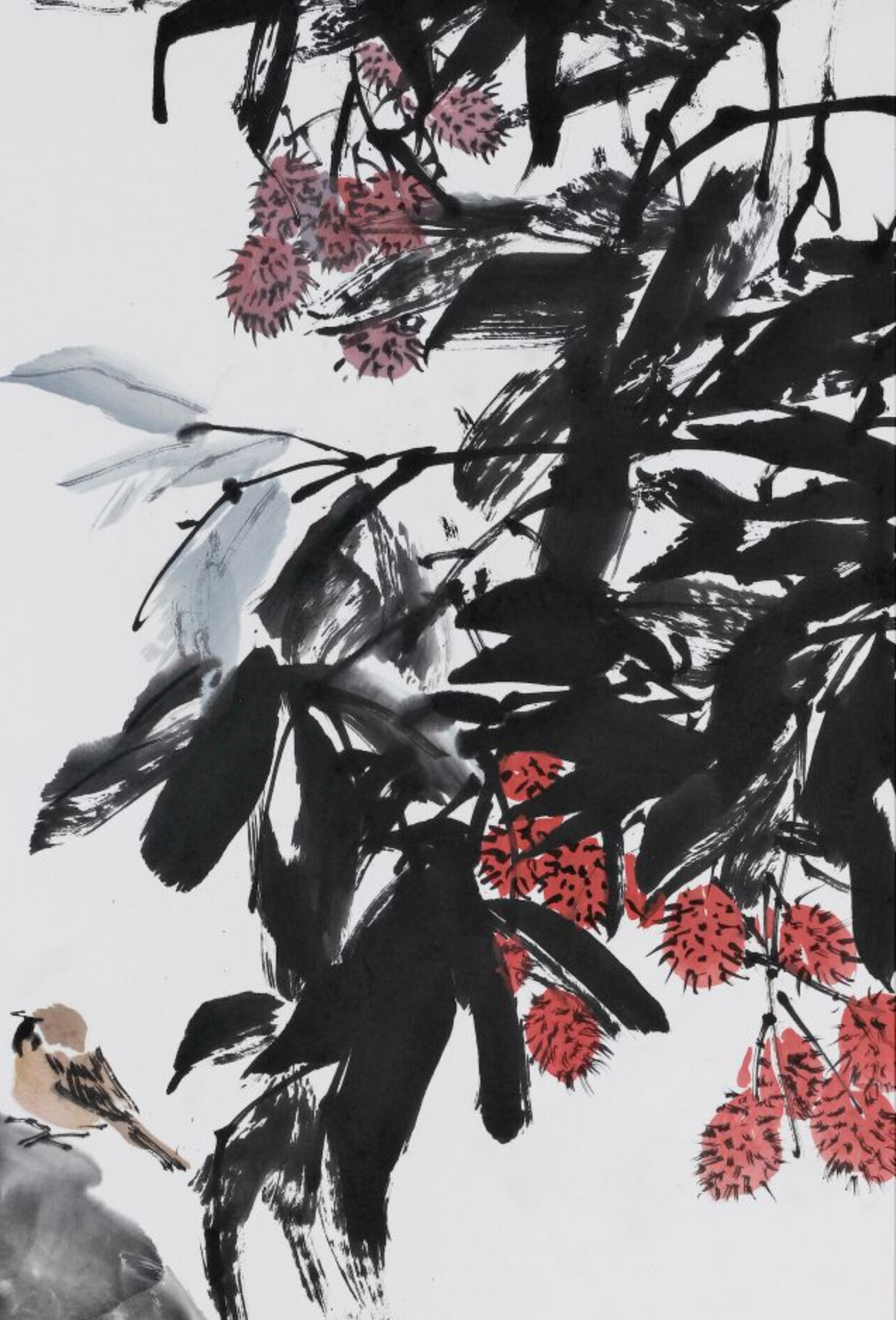
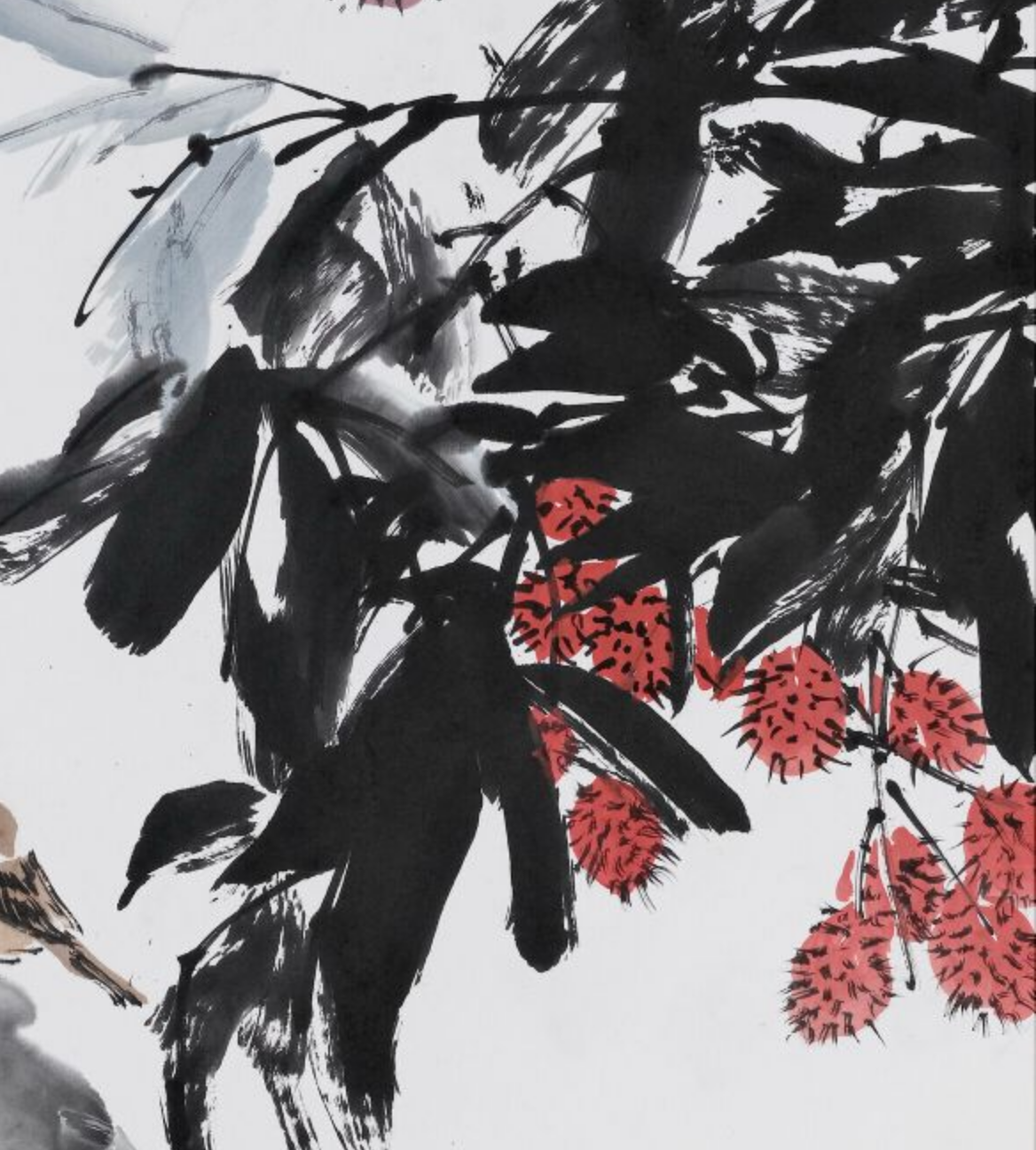
The leaves are rendered with bold, calligraphic strokes in rich black ink, contrasted with some dry strokes to create texture and tonal variation.
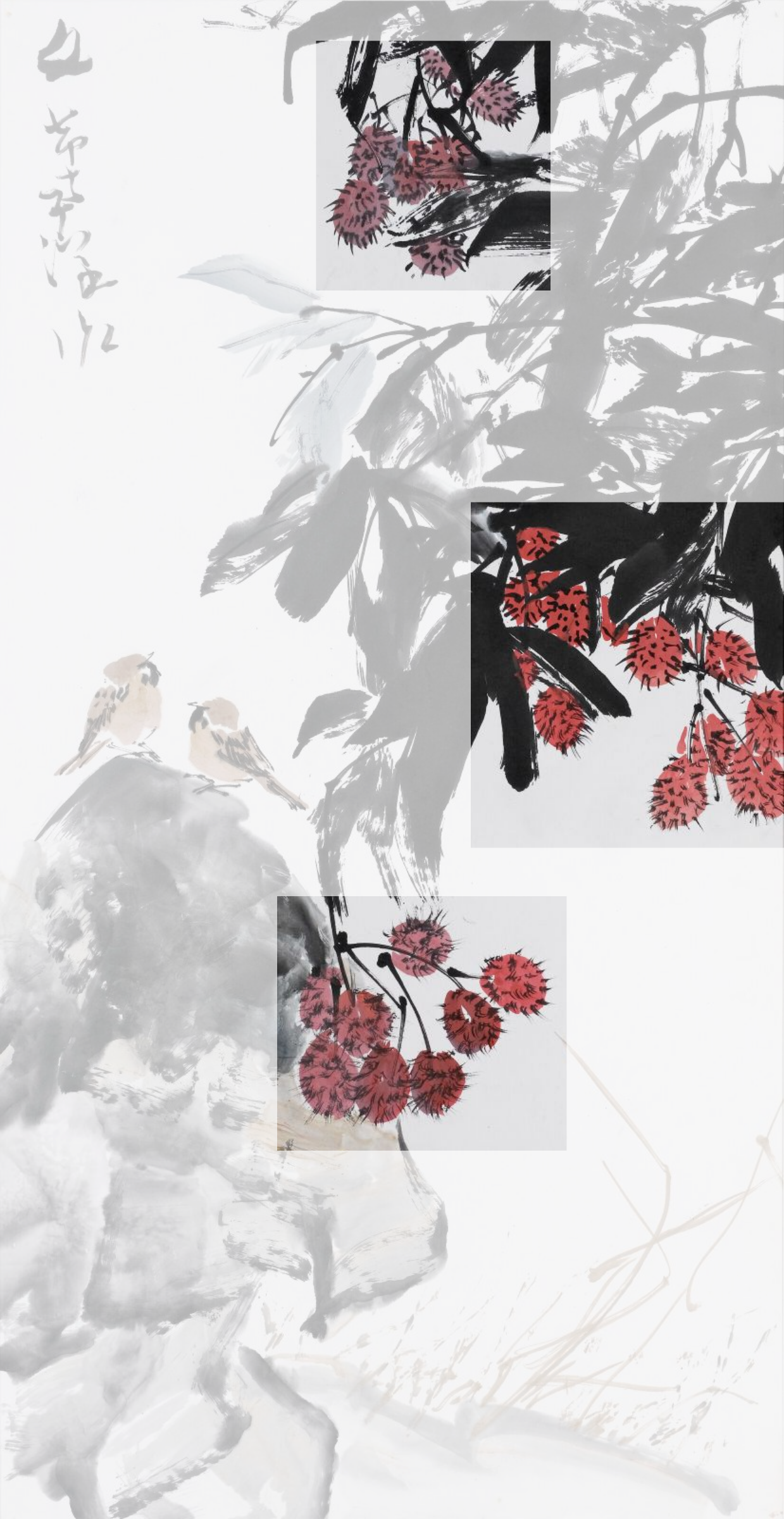
The rambutans are painted in varying shades of red, complete with fine black lines to suggest their rough spikes.