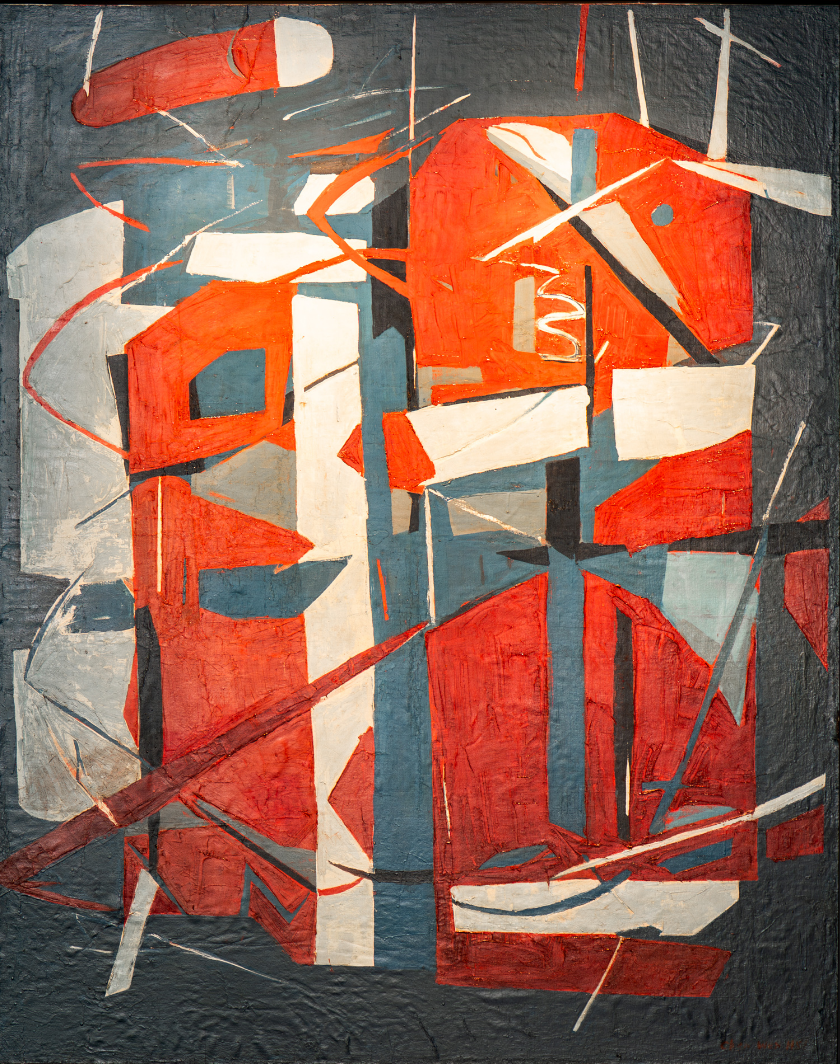
Puppets
Chen Wen Hsi. c.1960s, Oil on canvas laid on board, 153.5 x 121.5 cm
b. 1906, Baigong Village, Guangdong Province, China - d. 1991, Singapore
Chen Wen Hsi (1906-1991) was one of Singapore's most important pioneer artists and art educators. His work played a crucial role in shaping the Nanyang art style, which fuses Chinese art traditions with Western modernist influences and Southeast Asian themes. Chen’s earlier art training in China grounded him in classical Chinese aesthetics, particularly calligraphy and ink painting, while also exposing him to Western Modern art movements like Cubism and Post-Impressionism. He excelled in both oil painting and traditional Chinese ink, often moving effortlessly between the two.
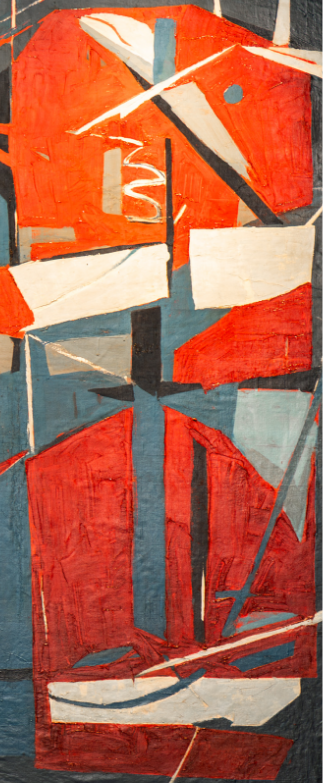
Flat and striking in its bold simplicity, Puppets is characteristic of Chen’s spirited engagement with geometric abstraction as a visual language in the period of 1950s-1960s. The composition is parred down to angular planes, intersecting lines, and pure shapes with hard and soft edges. Red, the most dominant colour, anchors as solid mass but also pulses across the surface with urgency, tempered by cooler blues and whites that provide interesting contrast and spatial tension.
The outcome of the image is harmonious, rhythmic, and dramatic, even as the visual elements resist identification. The assertiveness of the lines, the tension between expansion and compression of space, and the strategic placement of shapes all suggest a painter deeply attuned to the spatial poetics of both Chinese ink and Western pictorial techniques.
Compositional Breakdown
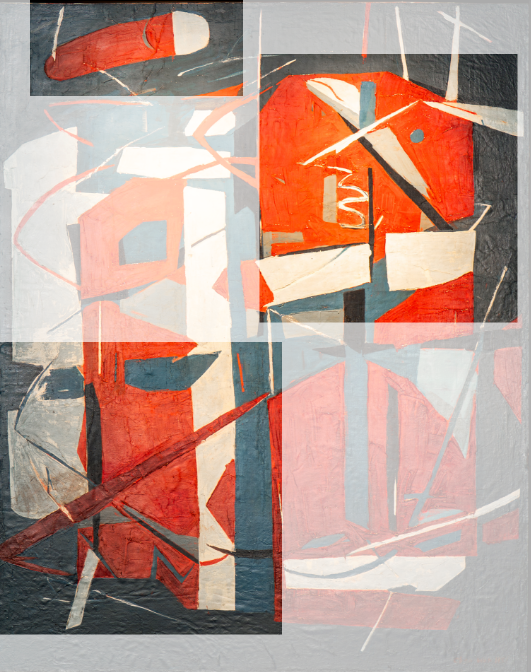
The composition is flat and striking in simplicity - parred down to angular planes, intersecting lines, and pure shapes with hard and soft edges.
Red, the most dominant colour, anchors as solid mass but also pulses across the surface with urgency, tempered by cooler blues and whites that provide interesting contrast and spatial tension.