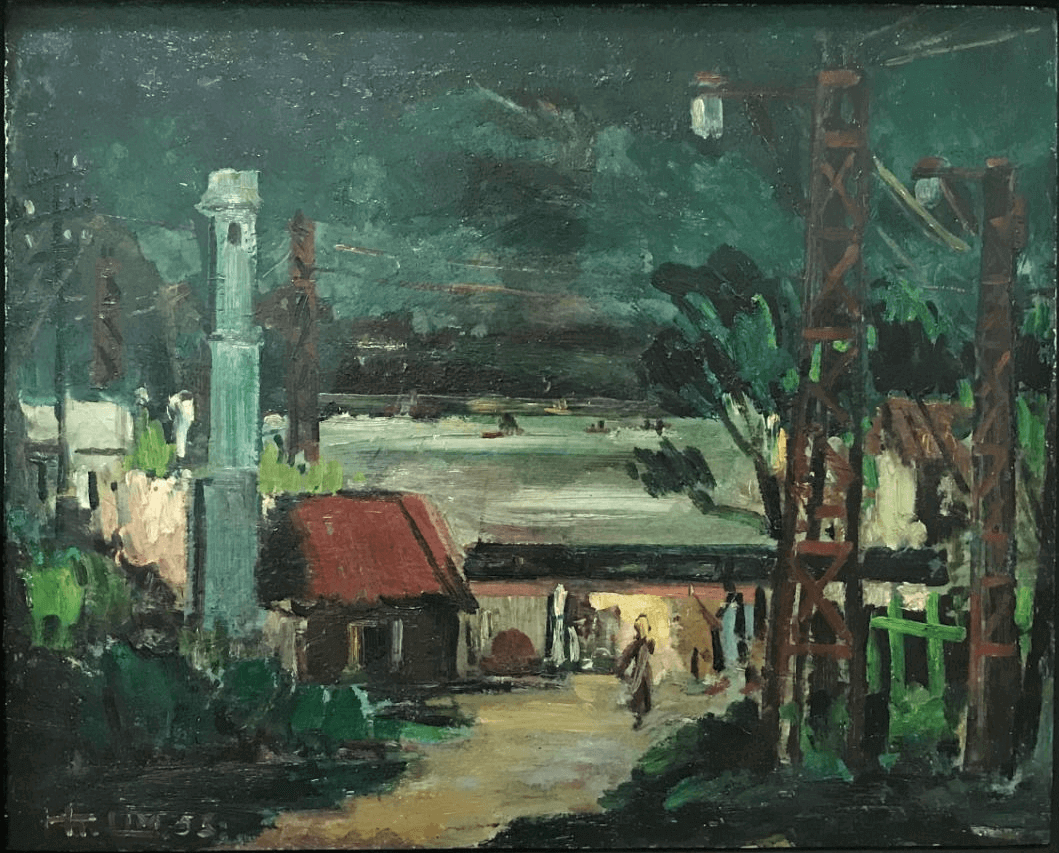
Night at Keppel
Lim Hak Tai. 1955, Oil on canvas, 48 x 60 cm
b. 1893, Xiamen, Fujian, China - d. 1963, Singapore
Lim Hak Tai (1893–1963) was one of the most influential pioneers of modern art and art education in Singapore. Born in Amoy (Xiamen), China, Lim received a classical education and trained in Western painting at the Fujian Provincial Teachers’ Training College from 1913-1915. He taught in several provincial art institutions and co-founded the Xiamen Academy of Fine Arts in 1923. As an artist and educator, Lim was influenced by the ideals of the May Fourth Movement in China in the early 20thcentury, which advocated for the modernisation of Chinese art and cultural discourse by integrating Western artistic developments.
Around 1936, Lim relocated to Singapore and worked as a teacher at the Chinese High School. He founded the Nanyang Academy of Fine Arts (NAFA) in 1938 and served as its principal for 25 years until his death in 1963. NAFA was modelled after Chinese formal art academies and was the first art academy in Southeast Asia to offer a curriculum in both Western and Chinese art traditions.
As a principal and mentor, Lim advocated for the cultivation of a distinctly Southeast Asian artistic identity. This was vital to the development of the Nanyang art style in the early Singapore art scene. He encouraged field trips across the region,from Indonesia to Malaya, believing that immersion in local cultures and landscapes was essential for artistic innovation. His writings and lectures articulated a philosophy of cultural synthesis rooted in observation, empathy, and respect for the diversity of the region.
Throughout his career, Lim dedicated much of his time to leading the education system at NAFA as well as raising funds to keep the academy afloat. As a result, he was left with little time to paint and concentrate on his own artistic production. To date, only about 100 artworks by Lim are known to exist.1
Lim painted mainly in oil, though he was also proficient in Chinese ink and gouache. His paintings often depict local subjects such as kampong life, tropical flora, and the Malayan landscapes. There are also works that reflect his experimentation with cubism and abstraction.
Night at Keppel from 1955 reveals a careful balance between structural clarity and lyrical sensibility, reflecting Lim’s modern academic training and expressive use of form and colour. The scene is anchored by rural dwellings and a tower-like structure, with a vista that recedes towards a harbour in the distance. The presence of looming metal pylons speaks to the arrival of modern infrastructure. In the lower-middle, an indistinct figure strolls along the path, appearing small against the surrounding structures and the vastness of the environment.
Rendered in broad, painterly brush strokes and a palette rich in deep blues, greens, and muted earth tones, the painting conveys a sense of calm and introspection, as if the landscape is caught in a moment of stillness before nightfall.
Compositional Breakdown
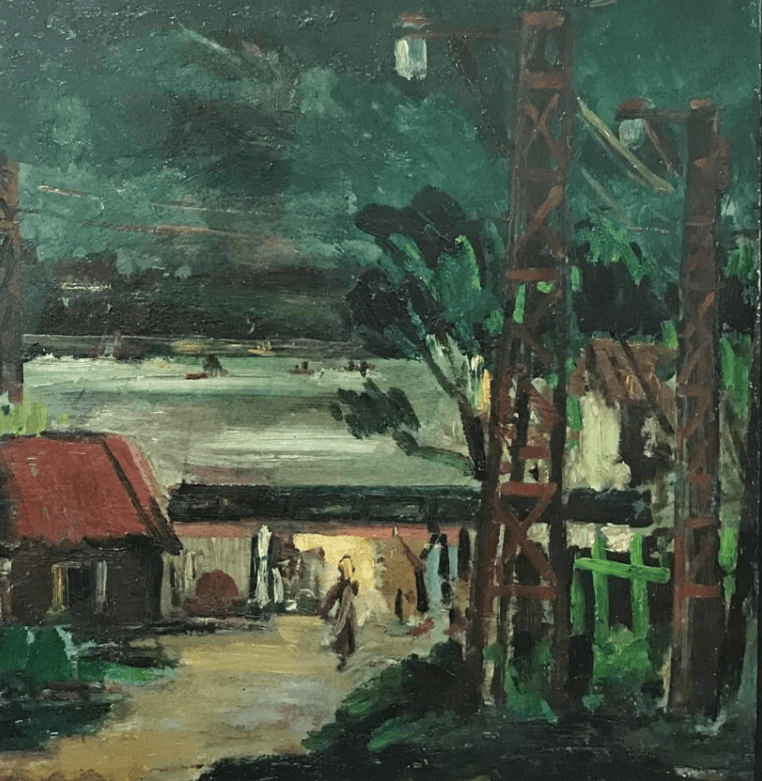
The composition reveals a careful balance between structural clarity and lyrical sensibility, reflecting Lim’s modern academic training and expressive use of form and colour.
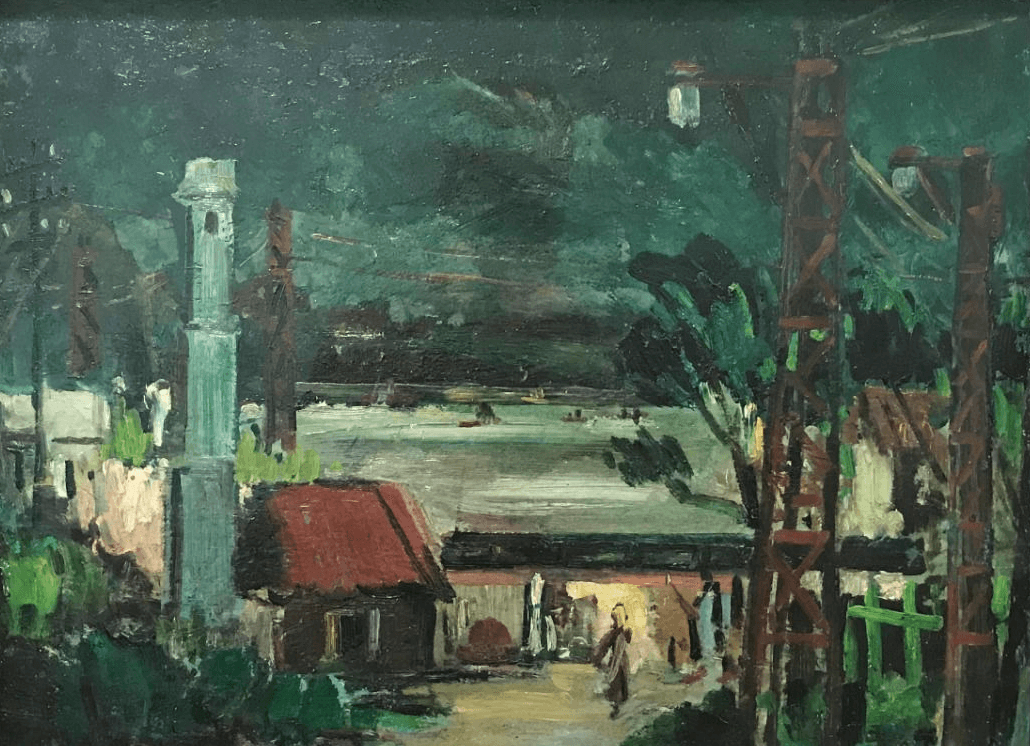
The scene is anchored by rural dwellings and a tower-like structure, with a vista that recedes towards a harbour in the distance. The presence of looming metal pylons speaks to the arrival of modern infrastructure.
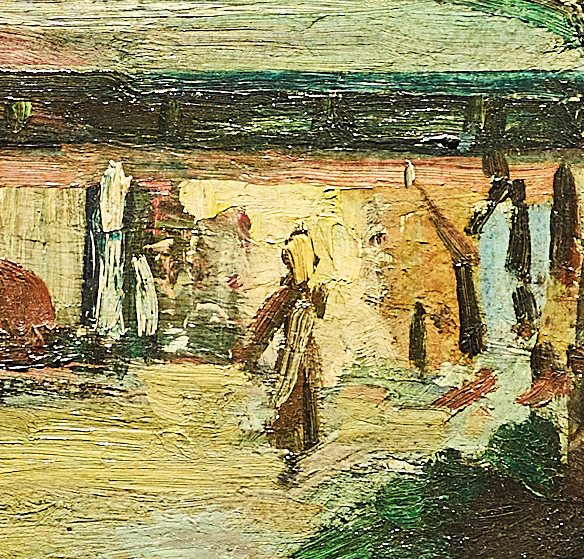
In the lower-middle, an indistinct figure strolls along the path, appearing small against the surrounding structures and the vastness of the environment.