Nanyang Landscape
Chen Chong Swee. c. 1970s, Inscribed and signed in Chinese by Liu Kang, Chinese ink and colour on paper, 68 x 101 cm
b. 1910, Chenghai County, Guangdong Province, China - d. 1985, Singapore
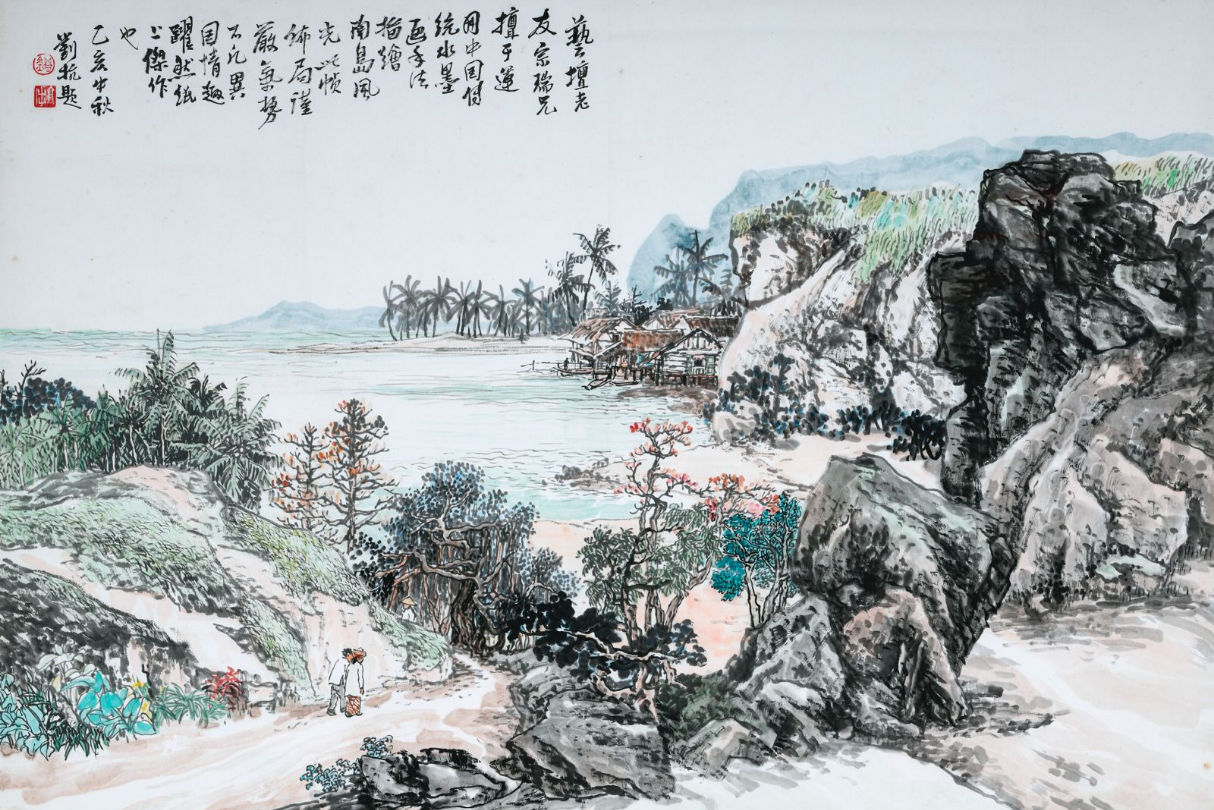
Chen Chong Swee (1910-1985) was an important pioneer artist, educator, and art theorist in the Singapore Modern art scene. A leading proponent of the Nanyang art style, many of his paintings blended Chinese literati traditions, Western modernist techniques, and Southeast Asian subjects.
Nanyang Landscape is a powerful example of how Chen masterfully adapted traditional Chinese ink painting techniques to depict Southeast Asian scenery, embodying the ideals of the Nanyang art movement. Chen employs a classical shanshui (山水) format - the Chinese landscape painting tradition - to present the natural environment surrounding a Malay fishing village. He introduces localised motifs such as coconut palms, coastal huts, and tropical flora and fauna to replace grand mountains, Chinese pines and tiled pavilions.
Chen uses controlled brush strokes for the rocks and vegetation, with gentle washes of ink and colour that build up atmospheric depth. Also evident is his use of traditional Chinese brushwork in the rendering of jagged cliffs and foliage, a fine texturing technique in Chinese landscape painting known as cunfa 皴法. Two figures, dressed in Malay attire, stroll along a path that opens up to a coastal shoreline and a cluster of huts on stilts in the far end, anchoring the scene in its regional identity.
Along with two artist seals, the upper left of the composition carries an inscription by his nanyang contemporary, Liu Kang, reinforcing the Chinese literati aesthetic.
The Chinese calligraphy by Liu Kang reads:
My esteemed friend in the artworld, Brother Zong Rui (Chong Swee) demonstrates remarkable skill in adapting the traditional techniques of Chinese ink painting to capture the landscapes of the southern islands. In this work, a disciplined composition meets commanding presence, and a vivid sense of exotic allure springs to life on paper. It is, without doubt, a distinguished masterpiece.
Mid-Autumn, Year of the Boar (1995)
Inscribed by Liu Kang
[A loose translation in English]
Compositional Breakdown
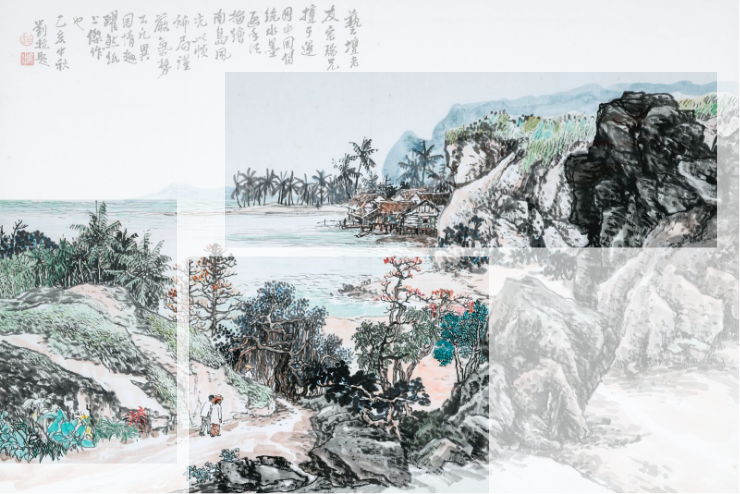
Chen employs a classical shanshui (山水) format - the Chinese landscape painting tradition - to present the natural environment surrounding a Malay fishing village. He introduces localised motifs such as coconut palms, coastal huts, and tropical flora and fauna to replace grand mountains, Chinese pines and tiled pavilions. Two figures, dressed in Malay attire, stroll along a path that opens up to a coastal shoreline and a cluster of huts on stilts in the far end, anchoring the scene in its regional identity.
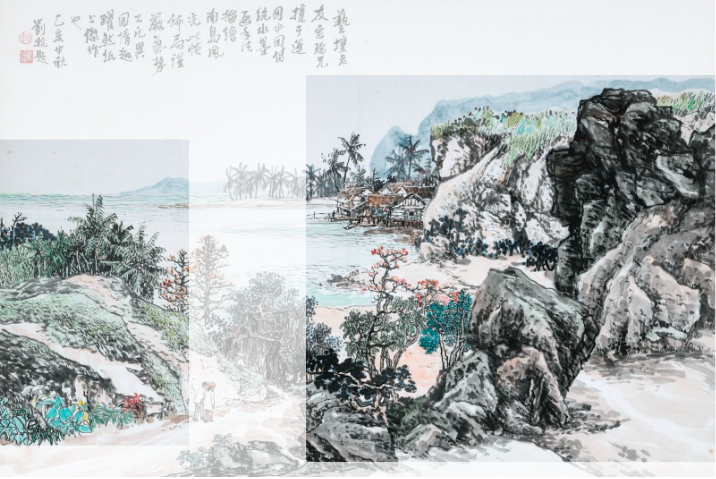
Chen uses controlled brushstrokes for the rocks and vegetation, with gentle washes of ink and colour that build up atmospheric depth.
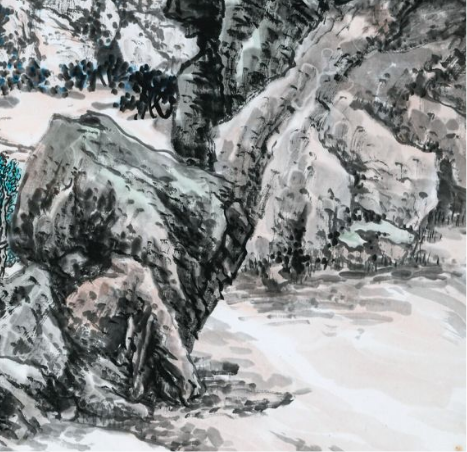
Also evident is his use of traditional Chinese brushwork in the rendering of jagged cliffs and foliage, a fine texturing technique in Chinese landscape painting known as cunfa 皴法.
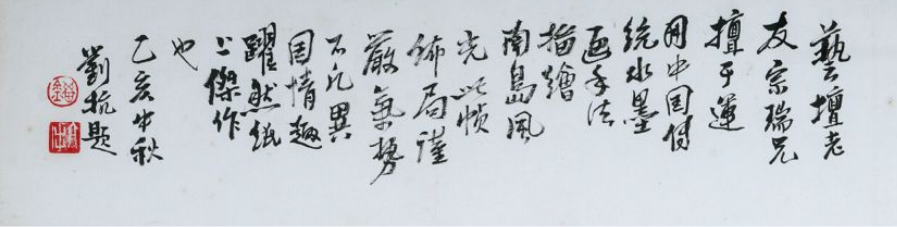
Along with two artist seals, the upper left of the composition carries an inscription by his nanyang contemporary, Liu Kang, reinforcing the Chinese literati aesthetic.