Herons
Chen Wen Hsi. c. 1970s, Ink and colour on rice paper, 139 x 69.5 cm
b. 1906, Baigong Village, Guangdong Province, China - d. 1991, Singapore
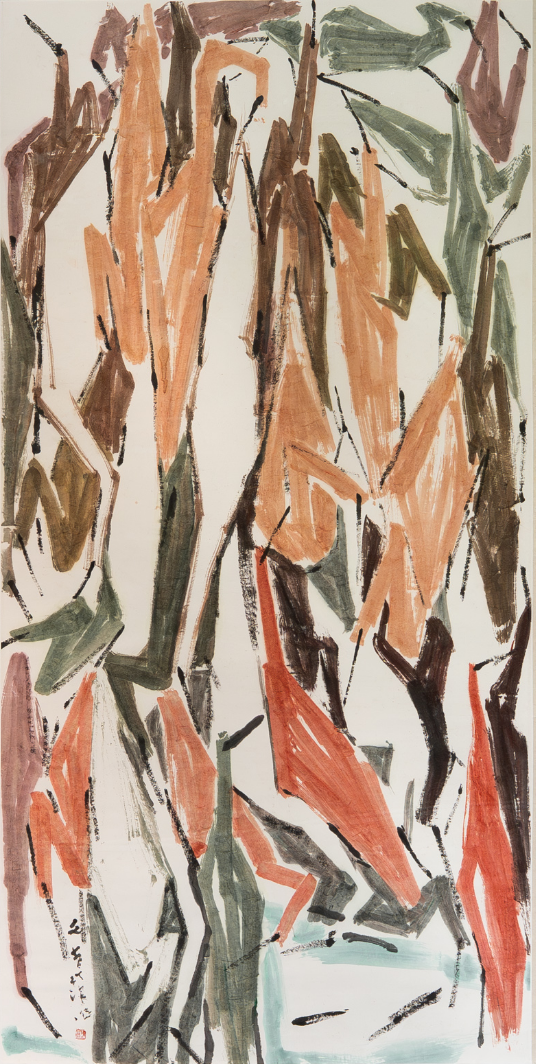
Chen Wen Hsi (1906-1991) was one of Singapore's most important pioneer artists and art educators. His work played a crucial role in shaping the Nanyang art style, which combines Chinese art traditions with Western modernist influences and Southeast Asian themes.
Herons is a fine example of Chen’s East-West abstraction style, where he pushes the boundaries of traditional Chinese ink and color painting towards a bold, modern visual language. Chen breaks from realism to reveal a gathering of herons in this composition, which borders on pure form and gesture. His treatment of the subject feels organic yet geometric, vibrant yet meditative.
At first glance, the work appears as a rhythmic arrangement of angular, interlocking shapes in earth tones - terracotta, olive, brown, and muted green - and punctuated by dynamic black strokes. The brush strokes in colours are bold, broad, and layered, while the black accents offer structure and contrast, creating an interesting tension and rhythm. The presence of turquoise at the bottom hints at water, grounding the composition in a natural environment, though the abstraction resists literal interpretation. Through thoughtful, expressive gestures, Chen achieves a complex interplay between form and essence, tradition and innovation.
Compositional Breakdown
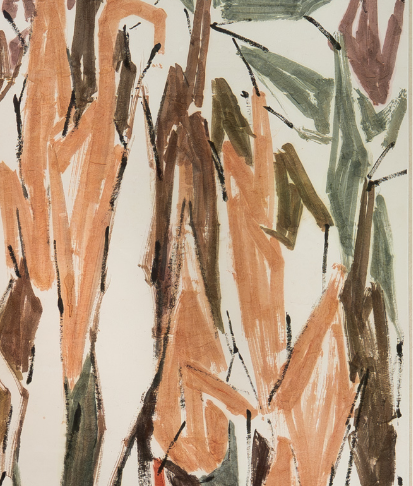
Chen presents a gathering of herons that borders on pure form and gesture. At first glance, the image appears as a rhythmic arrangement of angular, interlocking shapes in earth tones - terracotta, olive, brown, and muted green - and punctuated by dynamic black strokes.
The brushstrokes in colours are bold, broad, and layered, while the black accents offer structure and contrast, creating an interesting tension and rhythm.
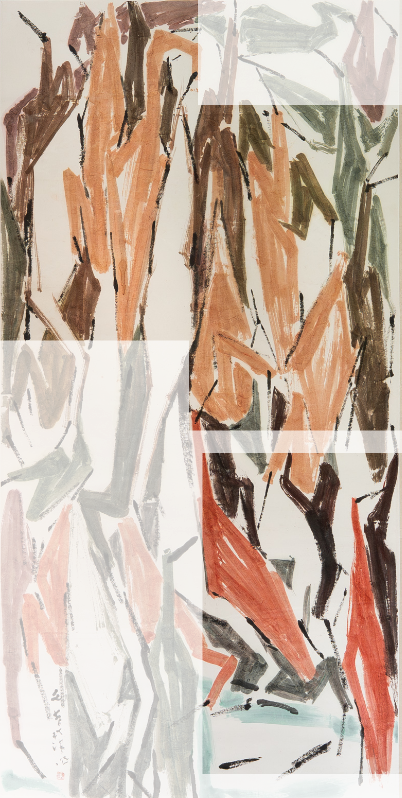
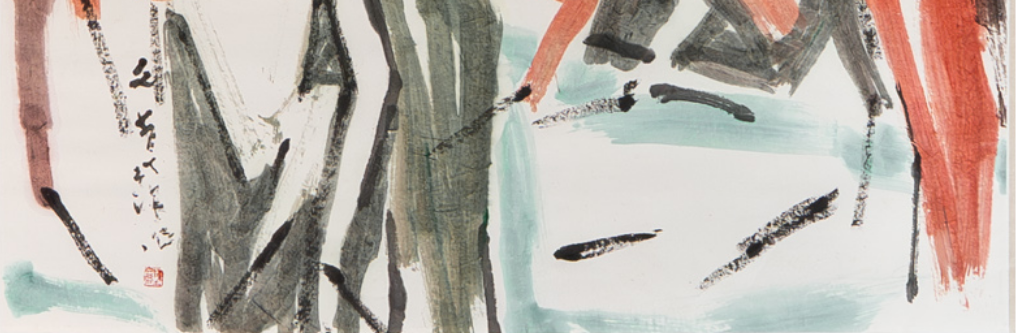
The presence of turquoise at the bottom hints at water, grounding the subject in a natural environment, though the abstraction resists literal interpretation.