Splendour in the Grass
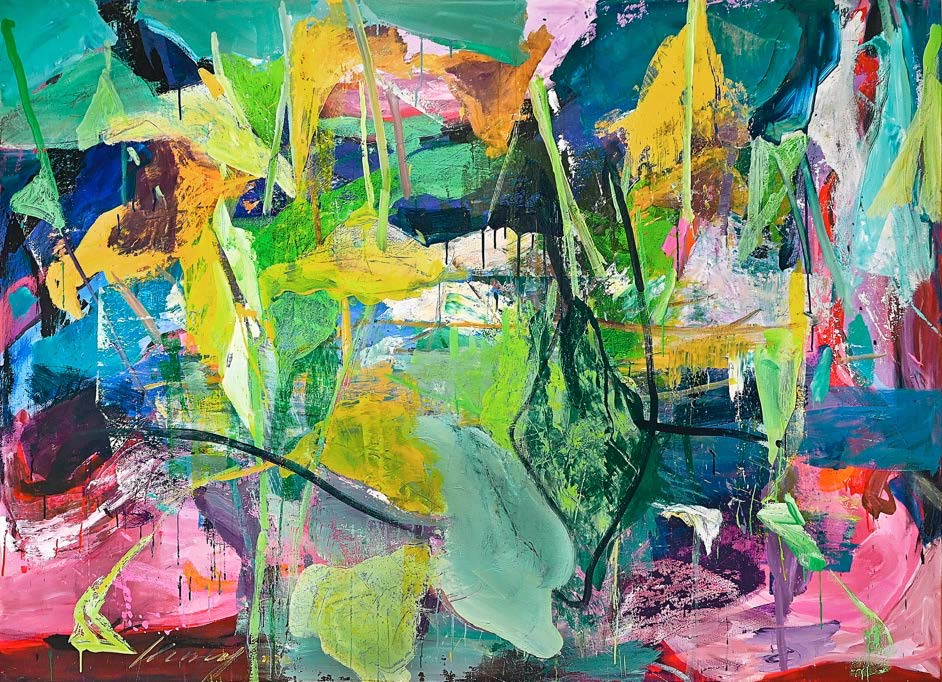
Wong Keen. 2022, Acrylic on canvas, 152 x 208 cm
b. 1942, Singapore
Wong Keen (1942- ) grew up in a Chinese literati environment where his parents were part of the émigré circle of Chinese artists and educators in Singapore. Wong’s mother, a Chinese teacher at the Nanyang Girls’ High School, was a lifelong calligrapher who trained in the art form since aged 5. His father taught Chinese history and literature at the Chinese High School, where his family resided at the teachers’ quarters and were neighbours with Chen Wen Hsi.
At 11, Wong began drawing lessons under Liu Kang for a year and later learnt Western and Chinese painting under the tutelage of Chen Wen Hsi. An acclaimed young painter in the Nanyang art scene and one of Chen’s favourite students, he often spent long hours at Chen’s home and studio at 5 Kingsmead Road. After his first solo exhibition at the then National Library of Singapore in 1961, the 19-year-old Wong travelled to America to study at the Art Students League of New York, becoming the first Singaporean and earliest of Chinese artists to venture into the post-war American art scene.
In 1965, Wong was the first Singaporean and Asian of Chinese origin to be awarded the prestigious Edward G. McDowell Travelling Scholarship in the history of the Art Students League. With the scholarship, he completed a one-year postgraduate program at the then St. Martin’s School of Art in London from 1965-1966. Over five decades in the US, Wong developed a distinct visual language that fuses the delicate expressivity of Chinese ink traditions with the bold formal experimentation of Western modernism.
Splendour in the Grass, which was inspired by lotus in nature, exemplifies Wong’s mature synthesis of Chinese painterly sensibility and Western abstraction. Colours collide, resist, and seep into surrounding forms, pulling together an intensely chromatic field that is familiar yet ethereal. The overlapping warm and cool hues push and pull against one another to create a dynamic spatial tension, evoking a poetic atmosphere akin to an ink wash landscape.
From edge to edge, Wong’s commanding colour play ventilates the tensions between will and surrender, abstruseness and lucidity. The dense surface, alive with sweeping strokes, drips, scrapes, and layered marks, recalls the physical immediacy of Abstract Expressionism while retaining a sense of lyrical restraint rooted in ink painting.
Compositional Breakdown
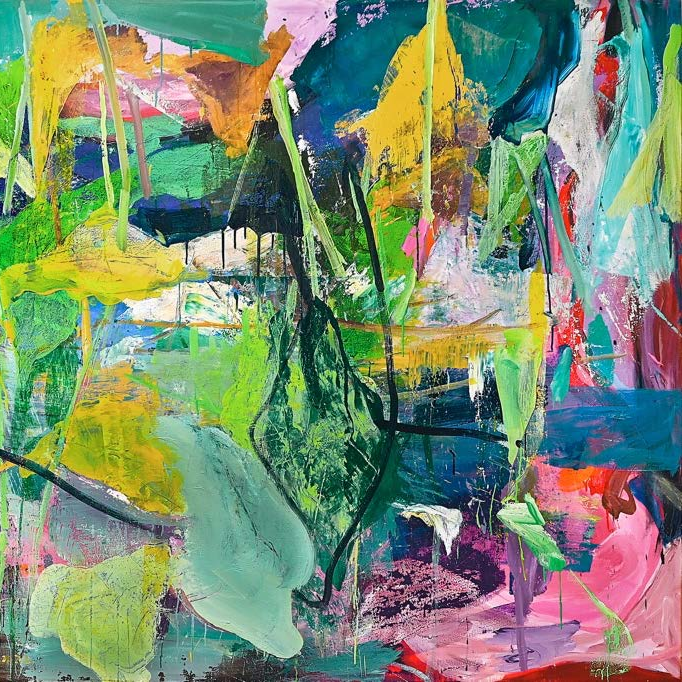
The overlapping warm colours (reds, pinks, oranges, and ochres) and cool colours (greens, turquoises, violets and teals) push and pull against one another to create a dynamic spatial tension, evoking a poetic atmosphere akin to an ink wash landscape.
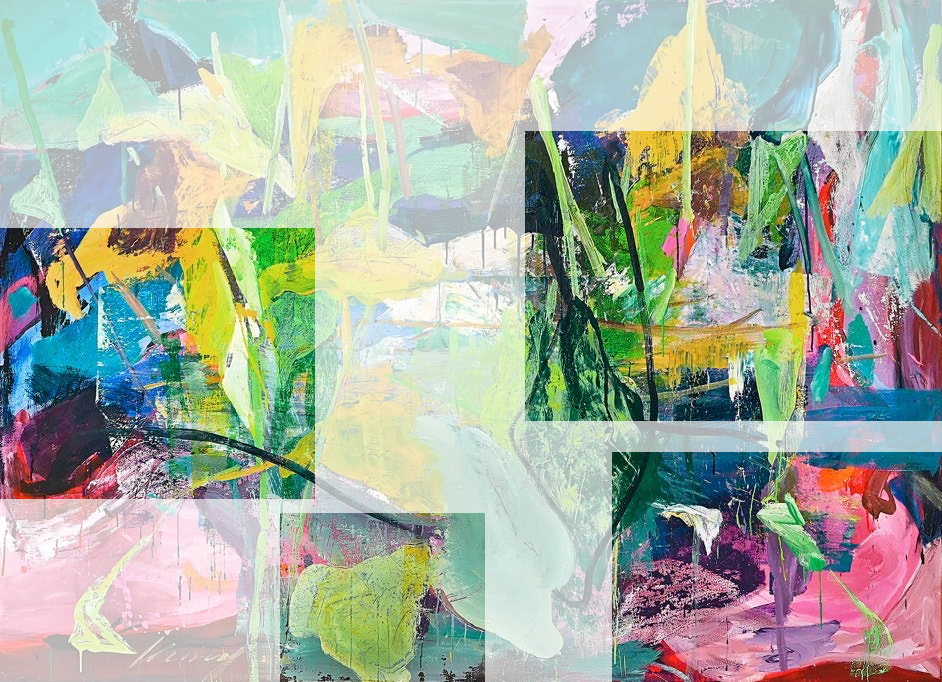
The dense surface, alive with sweeping strokes, drips, scrapes, and layered marks, recalls the physical immediacy of Abstract Expressionism while retaining a sense of lyrical restraint rooted in ink painting.