Kampong Scene
Cheong Soo Pieng. 1960, Ink and colour on paper, 95 x 38.5 cm
b. 1917, Xiamen, Fujian Province, China - d. 1983, Singapore
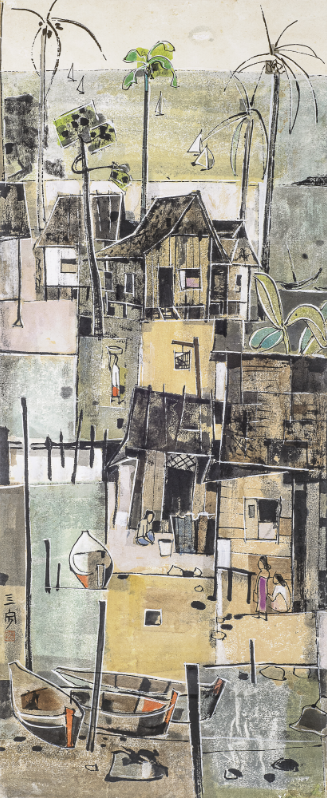
Cheong Soo Pieng (1917-1983) was a leading pioneer of the Nanyang art style and a trailblazing figure in the early Singapore art scene. Throughout his artistic career, Cheong demonstrated an unbridled drive for continuous experimentation and innovation across various mediums and styles.
Kampong Scene, executed in Chinese ink and colour on Chinese rice paper, is exemplary of Cheong’s early body of Nanyang ink work. The painting depicts a dense coastal village characterised by wooden stilt houses, boats, coconut trees, and local inhabitants engaged in daily life. The composition relies on bold, expressive outlines and overlapping forms in geometric blocks and planes that are almost cubist in their abstraction, but softened by irregular contours and organic spacing. The layout is vertically oriented, drawing the eye from the boats in the foreground up through the layered architecture to the serene sea and sailboats in the background. Cheong also applies dry brush textures and subtle layering to create depth and tactile richness.
Like many of Cheong’s ink work in this period, Kampong Scene thoughtfully fuses Chinese brushwork, modern abstraction, and Southeast Asian subject matter, reimagining local Southeast Asian life through a modernist lens. The scene is calm and almost lyrical, capturing the lived rhythm of rural coastal life. Each figure and object - from the boats to the trees to the people - is simplified to its essential form, emphasising design and composition over realism.
Compositional Breakdown
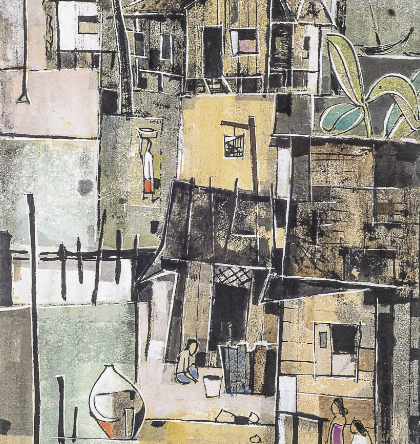
The composition relies on bold, expressive outlines and overlapping forms in geometric blocks and planes that are almost cubist in their abstraction, but softened by irregular contours and organic spacing.
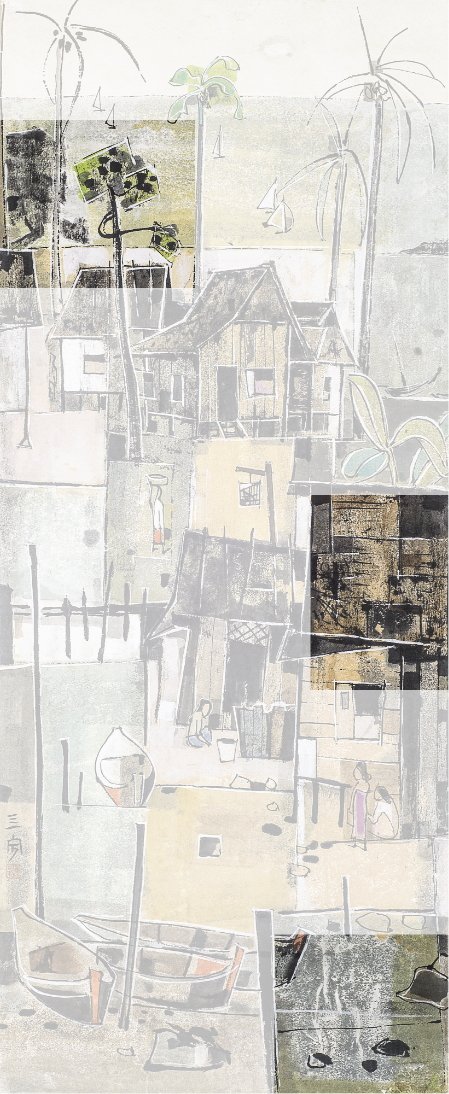
Cheong also applies dry brush textures and subtle layering to create depth and tactile richness.
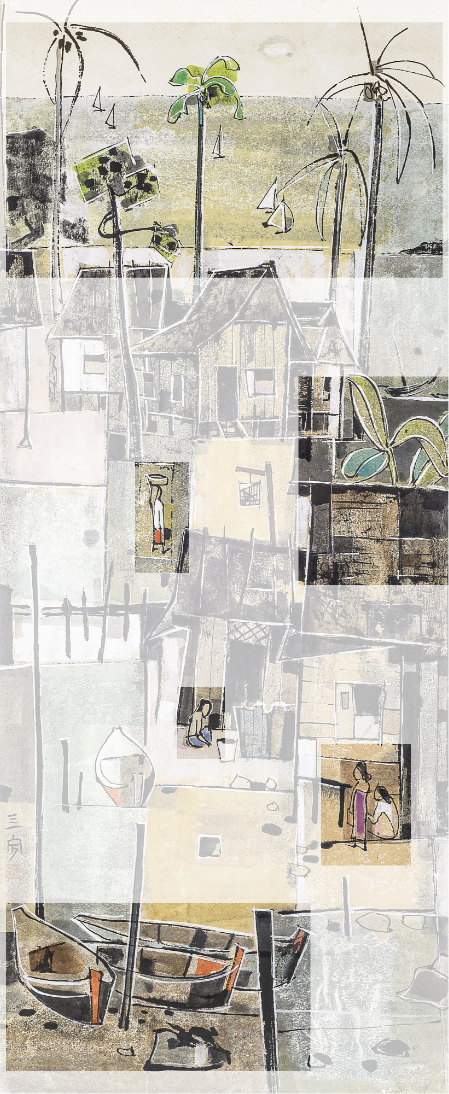
Each figure and object - from the boats to the trees to the people - is simplified to its essential form, emphasising design and composition over realism.